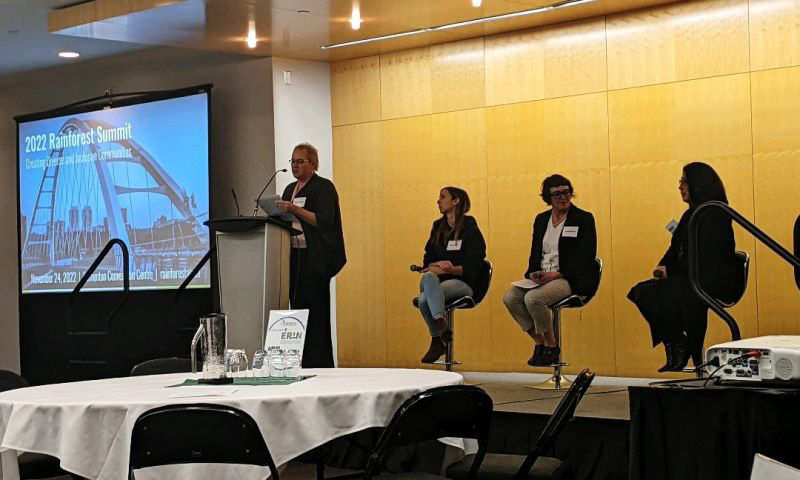
This last Thursday, it was an honour to participate in such a thought-provoking panel discussion at the Rainforest Alberta 2022 Summit. The atmosphere provided the psychological safety needed to foster such rich discussions throughout the day.
Before I get on with it, a bit about Rainforest Alberta first. Wow! This informal network of amazing humans that all share a belief in the fundamental principles of innovative cultures is something I can 100% stand with.
I signed the social contract.
Will you?
I recognize that some attendees may have auditory processing differences, making it difficult to remember the important messages that came from this discussion. I want you to engage with this information in a way that is meaningful and effective for you, so I am posting a written version of my key talking points.
What I can remember of them, at least. There were so many engaging questions from the floor that I didn’t write down and wish I could have captured, but I experience this auditory difference as well. It didn’t help that I forgot my earplugs at home either, because the room was bustling with a megaton of sounds and echoes.
Here is what I do remember with some additional notes and links to further reading… Fair warning, though. These were big concepts that we discussed, so this is a long post.
- Seeking out diverse minority voices
- Bridging the gap between differences
- Equitable opportunities and fair practices
- Addressing inclusivity at a systemic level
- Personal DEI journey
- Final thoughts and advice
Seeking out diverse minority voices
It can be challenging in some parts of our province to seek out diverse voices. What suggestions do you have for being inclusive when there are not a lot of visible minority groups?
I can’t speak to the experience of being a visible minority. I can only speak from the lens of being a woman working in non-traditional roles and through the experience of being neurodivergent (ND).
Even then, it’s important to recognize that there is diversity within diversity. Diversity within the voices of the hard to reach, under-represented and marginalized groups that needs to be amplified too. The expression we use to describe this is ‘when you’ve met one autistic person, you’ve only met one autistic person’. Don’t assume that the voice you are amplifying is representative of the whole community.
When you are seeking out the voices of lived experience, remember that not all advocacy groups are representative of the voices we seek. Not all literature is an accurate interpretation of the lived experience.
The medical model describing the ADHD or autistic experience is a perfect example of this. Does it make sense to prioritize the information you get from neurotypical (NT) people trying to explain the ND experience through the biased lens of their observations? Just because they are doctors doesn’t mean they have an accurate understanding of our lived experience.
Yet all too often we talk over ND voices in the workplace about their experience and needs. Emphasis is placed only on what the doctor says. Instead, we need to create a respectful space for self-advocacy.
Whether you are learning by engaging with people or through literature, remind yourself that the people you are trying to include are the real experts.
We also need to create a genuinely safe and open environment to normalize discussions about inclusivity, or exclusivity rather. These can be very uncomfortable conversations to have, especially when it requires us to challenge our biases and manage our emotions and defenses.
Embrace your vulnerability and learn to be comfortable with the uncomfortable. You will make mistakes and there will be misunderstandings. We don’t expect perfection. We are only looking to see progress.
You would be surprised at how many diverse voices are within your existing network that can help you understand what impactful inclusion looks like. When I decided to come out and disclosed to my colleagues that I am ADHD and autistic, I was astonished that over 25% disclosed their own ND to me.
When it becomes normal to have these conversations, being inclusive will happen organically.
The question I would really be asking ourselves is: are these voices in fact ‘hard to reach’ or is this just another one of our biases?
Bridging the gap between differences
We are in times where the differences in values and upbringing between generations in the workforce is a wide gap. Certainly, between Baby Boomers and Millennials, and even between older and younger Millennials. And Gen Z is an entirely different animal from either. What are your suggestions to bridge those gaps, reduce conflict and build respect?
My advice is true of navigating any difference. We face all sorts of differences at work and in our personal lives whether it be values, thinking styles, communication, etc. It becomes even more complex when we factor in the many things that contribute to our differences: age, culture, race, neurodiversity, socio-economic status, life events, etc. Differences are inevitable because every one of us has a different lived experience.
Start with the one thing we all have in common… we all experience the human condition. “We don’t see things as they are, we see things as we are” (debated origin). What we think we hear is different than what was said because our unconscious brains interpret what we hear through a series of personal historic filters. This is not an objective interpretation.
Autistic research refers to this as the ‘theory of double empathy’ and the ability for ‘two-sided perspective taking’. As an interesting side note, autistic people are stereotypically labelled as having a deficit in these abilities, even by medical professionals and people in support roles. Yet studies show that autistic people and NT folks have an equal ability for two-sided perspective taking. I would argue that in many circumstances we show a greater ability for navigating these differences considering we have historically carried the burden of ‘improving our deficits’ and we have access to many communication skill-building supports. The responsibility to bridge the gap of differences is two-sided.
To do this, you need to be mindful about how you are experiencing this. Look inwards first. What are your behaviours telling you? What are your emotions and thoughts telling you? I guarantee there is always more to your reaction below the surface. When we focus on our own inner work it is remarkable how we begin to ‘respond’ instead of ‘react’, resulting in far better outcomes.
Believe that every experience is valid. My a-ha moment came when I realized that two truths, although vastly different, could exist at the same time. One of my therapists had a really neat 3-D object. Depending which side of the room you were sitting, it either very clearly read ‘black’ or it very clearly read ‘white’.
But truths aren’t black or white. We don’t own a monopoly on the truth. One experience is not more valuable or superior to the next. One is not right while the other is wrong. They are simply different. Accept that there are many truths in opposing views.
Acknowledge and embrace differences. Differences aren’t a bad thing to avoid. There are many strengths from within a diverse group we can draw from. Differences translate to opportunity that results in innovative and more successful solutions.
Equitable opportunities and fair practices
Let’s talk about equity. How do organizations assure equitable and fair practices for all employees in a hybrid workplace?
This was an interesting question for me because the move to a virtual environment actually made things fairer for me during covid. I was definitely in the minority in how I experienced this, even within the ND community. It was the first time I genuinely felt like I belonged, was being included and was being judged fairly.
While others experienced a disadvantage, I experienced advantages. For example, I heard from many people that their ability to ‘read the room’ was reduced in the virtual environment. Yet I was finding it much easier because I could decode facial expressions better when they were lined up in a structured row. There were also less auditory distractions competing for my attention. I didn’t have to listen to people breathing, to squeaky chairs or to the sound of moving air.
In general, there was less reliance on the social-emotional and non-verbal aspects of communication. This is something that will never be a strong point for me. We judged more on our ability to articulate our thoughts using words, and this is one of my communication strengths. Written contributions to teamwork were also valued more.
This and many other things lessened the cognitive load and stress load of having to navigate an environment designed for the NT experience. I could focus on the actual work I was doing. I was much more productive, and the quality of my work improved substantially.
With this shift to hybrid environments and having some people back in the office, we are back to favouring the subjective social aspect of competency. I am back to where I started pre-pandemic with being disadvantaged.
Hybrid environments only compound an existing inequity problem that needs to be dealt with. Arguably, we need to get better at providing equitable opportunity and fair practices in the office first before we focus on strategies specific to the hybrid model.
This shift is good, though. It puts pressure on employers to provide a better experience. They will need to address the root causes that lead to inequities, even for the NT community. They will need to re-evaluate their practices. A few key welcomed and long overdue improvements I think we will see are:
1.) We will have more objective performance evaluations. Competency will be judged more on the work being performed instead of on socializing abilities.
2.) Managers will need to develop a greater level of skill in managing projects and teams. When our operations are functioning better, we will be less inclined to blame employees for deficiencies.
3.) We will see more transparent and inclusive communication. Those informal and decision-making discussions that historically disadvantage ND folks will be discouraged. Instead, we will see more intentional and fair opportunities to access leadership being provided.
Addressing inclusivity at a systemic level
We spoke a lot about meeting individual needs. What strategies can we use at a systemic level to be more inclusive?
It is a recurring experience in the autistic community that our accommodation requests are denied because our employers and benefit providers don’t trust our lived experience and self-advocacy.
Even our medical teams try to explain that they can only provide evidence of a diagnosis and that we experience the diagnosable traits. Our specialists are unable to specify our dynamic experience as we interact with different environments, different social situations or our ever-changing nervous systems. They are unable to specify exact strategies that will help us as an individual thrive. We are the only ones able to advocate for our individual experience and specific needs.
It is also extremely important to recognize that getting an ADHD or autism spectrum disorder (ASD) diagnosis is a privilege. Without a diagnosis, employers do not have to accommodate our disability needs.
Access to assessment services and the very limited number of specialists with expertise in differential diagnosis, especially those that are knowledgeable in the different presentations of women, can be a challenge. Another challenge is that the DSM diagnostic criteria are deeply flawed and biased to the traits that young boys typically exhibit. Studies suggest that males are more likely to be diagnosed than females at a rate as high of 6:1 in certain demographics. Sex imbalances in diagnostic rates are real, yet there still isn’t concrete evidence to prove that there are fewer autistic females. (As a side note, this study uses a gross pathological narrative of autism, but the data is valid none the less.)
It is very often a very dehumanizing experience to go through the formal accommodation process. Ironically, nine times out of ten we aren’t even seeking accommodations. We simply just want to be included and be given the flexibility to do our jobs well.
For example, is asking that digital documents over a hundred pages long support the standard navigation functions built into the software so that I can navigate the document without forgetting what I was looking for by the time I scroll to page three really an accommodation? Is asking that people don’t write with big blocks of size 10 italicized font so that the information I need to do my job doesn’t become a big floating sea of beautiful shapes really an accommodation? Yet when I self-advocate my need to quickly reformat these documents, I am told that “this is a nice to have, not a need to have”.
We need to re-evaluate the accommodations system. Wouldn’t it be nice if we could just be universally inclusive instead of having to use the formal process? I’d call that a win-win for both ND individuals and employers.
Personal DEI journey
Tell us about your personal DEI journey and how you got into the business of DEI.
It’s exhausting fighting for your rights to not be discriminated against. There came a point where I had to choose. I could exhaust my energy fighting the system using the very flawed system that led to me losing my job repeatedly. Or I could invest my energy into influencing change within individual people. One person at a time, so that eventually the needle will tip to a point where it will be an inclusive and accessible society for all. A society where ND folks belong.
Final thoughts and advice
What are your final thoughts and what advice do you have for founders struggling to attract talent in a global, gig economy?
It takes intention to create equity and inclusion. If you aren’t actively and genuinely doing this, then it’s very likely you are being exclusive without even realizing it.
Recognize that most beliefs regarding how we do things, how we view competency and how we behave are only arbitrary social norms that historically change over time. Yet we place so much emphasis on these being the standard that we judge against. During the interview process, as we delegate work and in our performance evaluations.
Consider the fact that I was the only panelist who had a printed copy of my speaking notes even though it is not customary in this setting. Why is that? I need to have them. Heck, I can’t even remember half-way through my shower if I washed my hair. Is it realistic to expect me to remember all my talking points and not become a rambling fool? They were also helping me to regulate my nervous system. Something concrete I could hold on to since there wasn’t a table that I typically place my various tools on.
I bet many of your first impressions were that I was inexperienced and you had the expectation that my comments wouldn’t be as engaging as the other panelists. Yet I am a seasoned keynote public speaker.
After listening to my responses though, I challenge you to question if using my notes really made me a less competent public speaker? Did it make my message less engaging? Did you trust me less? Did you pass biased judgement on me? If you did, don’t worry… I’m not judging. You experience the human condition too. So why do we hold these expectations?
It is your responsibility to achieve change, not mine as a person who experiences exclusion, judgement and rejection on a daily basis because of my disability. Or as I like to describe it, it only becomes disabling when I am expected to become an NT and try harder to succeed in a world designed for NTs. It is your responsibility to take initiative to gain a better understanding of our experiences. To actively listen to our voices better. To manage your own self emotions, thoughts and egos.
Accept that you have privilege. It may seem threatening to lose that privilege of being advantaged once we do achieve genuine diversity, equity, inclusion and belonging. I assure you, though, it will be a win-win achievement for all of us.
 Delta Learning Solutions